Buying Headphones Without Overpaying
Headphones are a category where price and satisfaction decouple quickly. Above a fairly modest threshold, what you are buying is a particular set of trade-offs rather than a straightforward improvement — and the trade-offs that matter most are exactly the ones a product listing describes worst.
Decide the form factor first
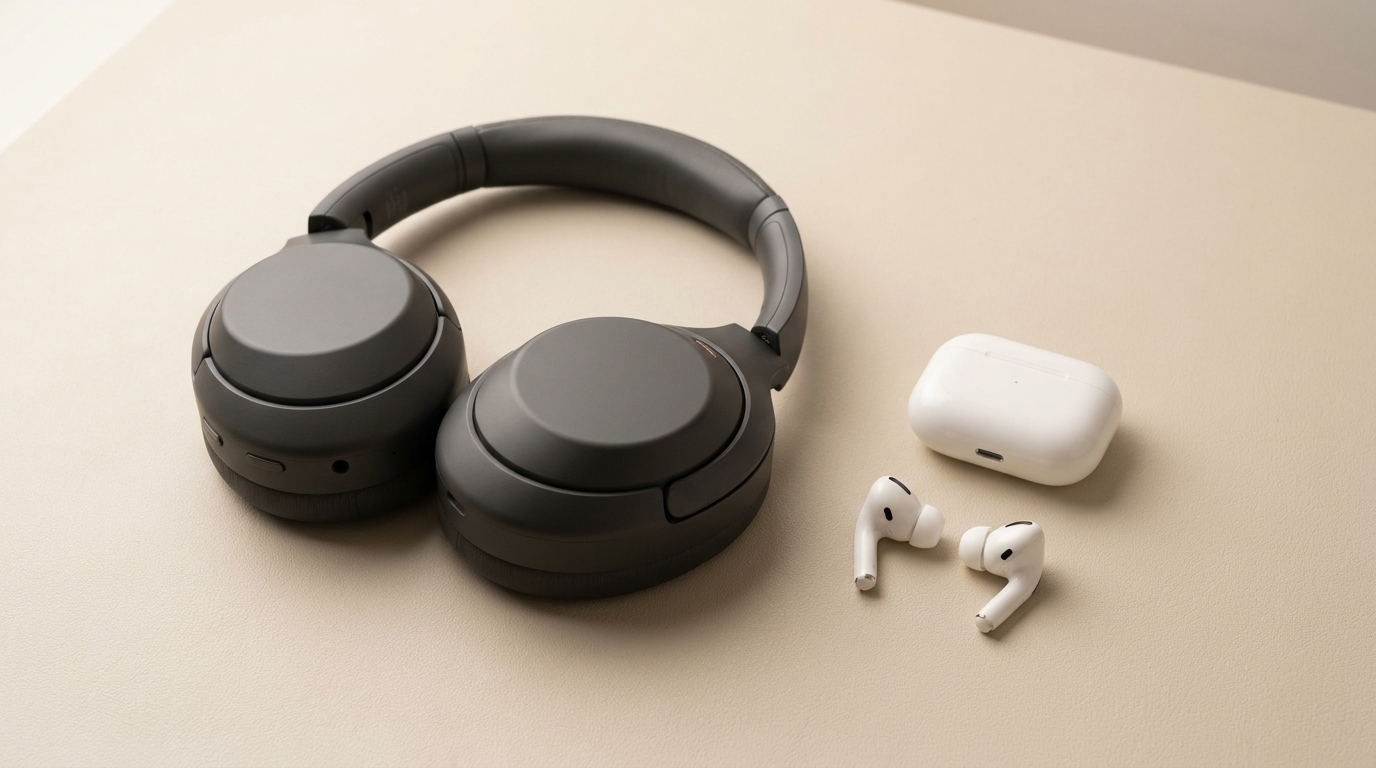
Over-ear designs generally offer the best isolation and comfort for long sessions, at the cost of bulk and warmth. On-ear designs are lighter and more portable but press on the ear and isolate less. In-ear designs are the most portable and can isolate extremely well, but fit determines everything: a poor seal ruins both bass response and noise reduction, no matter what the drivers cost.
This choice constrains sound quality more than most specifications do, so making it first eliminates most of the catalogue sensibly.
| Form factor | Strongest at | Weakest at | Typical battery (wireless) |
|---|---|---|---|
| Over-ear | Comfort, isolation, battery | Portability, warm weather | 30–60 h |
| On-ear | Weight, portability | Long-session comfort, isolation | 25–40 h |
| In-ear (buds) | Portability, gym use, calls on the go | Battery per charge, losability | 5–8 h (+case) |
Active noise cancellation has a shape
Active cancellation works best on continuous low-frequency sound — engine noise, air conditioning, train rumble. It works far less well on speech and sudden sounds, which is why an open office is a harder environment than an aeroplane. If your main enemy is a chatty colleague, isolation from a good physical seal often does more than another ten decibels of electronic cancellation.
Cancellation strength also trades against other things. Aggressive processing can affect tonal balance and, for some listeners, produces a pressure sensation. A transparency mode that sounds natural is often more useful day to day than a marginally deeper cancellation figure — you will use transparency dozens of times a day at a checkout, a ticket gate, a doorbell.
The specifications worth checking — and the ones that aren't
Frequency range is largely decorative; almost everything claims to exceed human hearing, and the number says nothing about how the headphones actually sound. What genuinely predicts your experience:
- Impedance and sensitivity — matters for wired models driven from a phone or laptop. High-impedance studio models (250 ohms and up) will sound quiet and flat without an amplifier; most consumer models (16–32 ohms) are fine from anything.
- Codec support, on both ends — a wireless codec only works if the headphones and your phone support it. A premium codec listed on the box is irrelevant if your device speaks only the baseline one, and the baseline is perfectly serviceable for most listening.
- Battery measured with ANC on — manufacturers quote the cancellation-off figure unless forced. Expect roughly 20–30% less with cancellation running.
- Multipoint — connecting to a laptop and phone simultaneously. If you take calls while working, this single feature affects daily satisfaction more than any acoustic spec.
- Replaceable pads — worn pads are the most common reason a good pair gets discarded. Pads cost €15–30; a new pair costs a lot more. Check the spare-parts listing before buying, the same habit that pays off across categories (see our guide to what warranties actually cover).
A worked example of the real comparison
Take two wireless over-ears: one at €120 with 40-hour battery, baseline codecs and fixed pads; one at €280 with 30-hour battery, premium codecs, multipoint and replaceable pads. Over four years, the cheaper pair likely gets discarded when the pads flatten in year two — total cost €240 for two pairs, with a repurchase hassle. The dearer pair takes a €25 pad refresh at year two and keeps going — €305, but with multipoint and better comfort the entire time. The sticker gap of €160 is really a gap of €65, plus features. This arithmetic, not the spec sheet, is the honest comparison.
Buy for the use you actually have
Commuting rewards isolation and battery life. Calls reward microphone quality, which is a separate engineering problem from listening quality and frequently poor on otherwise excellent headphones — check reviews specifically for microphone samples. Long desk sessions reward clamping force and weight above all. Critical listening rewards a neutral tuning, which many people find less immediately impressive in a five-minute demo than a boosted one, and more satisfying in month three.
Because fit and comfort dominate the experience and cannot be read from a page, buy from somewhere with a genuine returns window and use it properly — wear them for a few hours, take a call, sit through a commute. Pay attention to how you pay, too: a purchase this size deserves a payment method with real recourse, as covered in our guide to paying safely online.
FAQ
Are expensive headphones always better? Above roughly €80–100 for wireless models, you are buying specific strengths — cancellation, comfort, microphones, codec support — rather than across-the-board improvement. A €300 pair with the wrong form factor for your use will satisfy less than a €120 pair with the right one.
Is wired still worth considering? For desk use, yes: no battery to degrade, no codec compression, usually better value per sound quality. The battery is the component guaranteed to age in any wireless pair, and it is rarely replaceable.
How long should headphones last? Physically, a good over-ear pair with replaceable pads can serve five to ten years. Wireless models are effectively limited by their battery — typically three to five years of daily charging before capacity annoys you — which is worth weighing against a wired option if longevity matters to you.

Marcus tests the things people actually buy — headphones, laptops, kitchen gear — and cares more about what a spec sheet omits than what it advertises. He has handled enough refurbished returns to know which grades are worth it. He writes our product guides and buying advice.
More about our writers →More in Product Guides

Buying a Mattress Online Without Regretting It
The trial is the real product, comparison shopping is deliberately impossible, and firmness words mean nothing between brands. Navigate accordingly.
Small Appliances: Separating Machines from Marketing
Wattage is marketing; mechanisms are engineering. What predicts satisfaction is consumables cost, spare parts and the boring failure points.

How to Buy a Laptop You'll Still Like in Year Five
Laptops are bought on numbers and lived with as objects. The specs decide the purchase; the screen, keyboard and thermals decide the satisfaction.